Irish businesses are actively pursuing sustainability as a pathway to resilience, innovation, and growth
Sustainable practice and growth in business has never been more critical. In Ireland, a national commitment to achieve net-zero emissions by 2050 is reshaping how organisations operate, compete, and create value. As the regulatory landscape evolves and stakeholder expectations intensify, businesses across all sectors are recognising that sustainability is not merely an obligation — it is a strategic imperative. Understanding the drivers behind this shift is essential for investors, stakeholders, and business leaders seeking to align capital and strategy with long-term, climate-resilient growth.
This report draws on the findings of the Skillnet Climate Ready Academy’s Sustainability Leaders Programme (SLP), which analysed over 160 action plans completed by Irish businesses across 23 sectors. The programme, developed by 20FIFTY Partners in partnership with Skillnet Ireland, uses the UN Sustainable Development Goals (SDGs) as a framework for action, providing a robust evidence base for understanding what motivates Irish enterprises to pursue sustainability.
The four business drivers of sustainability
There are four main business driver categories among programme participants:
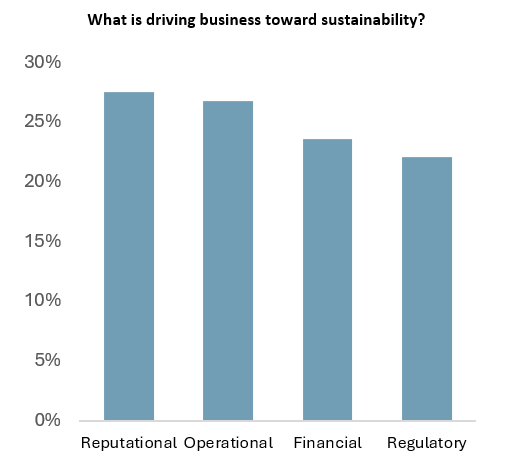
In-depth analysis of the programme’s action plans reveals that Irish businesses are motivated in each of the four categories in the following areas:
- Regulatory Compliance.
- Financial Opportunities.
- Operational Efficiency & Responsibility.
- Stakeholder Reputation.
Notably, these drivers are closely distributed in prevalence, indicating that businesses are pursuing sustainability holistically rather than in response to a single pressure point.
Regulatory compliance – 45% of regulatory drivers
Complying with the ever-evolving landscape is identified as the most significant regulatory factor driving sustainability engagement among Irish businesses. Directives such as the Corporate Sustainability Reporting Directive (CSRD) require organisations to meet rigorous reporting standards, and preparedness for future regulatory shifts is viewed as essential to long-term resilience. Businesses that invest in regulatory readiness today are positioning themselves to navigate change with confidence — reducing exposure to compliance risk and building organisational robustness.
Financial opportunity – 47% of financial drivers
A striking finding from the research is that more Irish businesses are motivated more by financial opportunity than by the risk of incurring costs. Enterprises are identifying tangible returns from sustainability investments, including reduced operational expenditure, access to green finance, and enhanced competitive positioning. This forward-looking orientation signals a maturing market in which sustainability is increasingly viewed as a source of value creation rather than a cost centre.
Operational efficiency & responsibility – 31% each of operational drivers
Efficient and responsible operations account for over 60% of operational motivations cited by programme participants. Businesses are prioritising waste reduction, responsible consumption, energy efficiency, and sustainable supply chain management. The alignment with SDG 12 — Responsible Consumption and Production — is particularly strong, underscoring a commitment to embedding sustainability into core business processes. Emerging technologies, including artificial intelligence and digital tools, are also seen as a significant opportunity to streamline operations and reduce environmental impact.
Stakeholder reputation – 42% of reputational drivers
Maintaining and increasing stakeholder satisfaction is the primary reputational driver. In an era where greenwashing poses a material reputational risk, Irish businesses are focused on credible, measurable sustainability commitments. Certification, industry awards, and transparent reporting are valued not only for brand enhancement but for their role in strengthening trust among investors, customers, employees, and partners. Stakeholder buy-in is recognised as fundamental to long-term business success.
Conclusion
The evidence from over 160 Irish business action plans paints a clear picture: sustainability is no longer a peripheral concern but a core business strategy. Regulatory preparedness, financial opportunity, operational excellence, and stakeholder trust are working in concert to drive meaningful change across Irish enterprise. With 61% of participants representing small and medium-sized enterprises, the findings demonstrate that sustainability leadership is not confined to large multinationals — it is increasingly accessible and actionable for businesses of all sizes.
For investors and stakeholders, these insights offer a compelling evidence base: Irish businesses are not merely responding to external pressure but are actively pursuing sustainability as a pathway to resilience, innovation, and growth. By continuing to support and engage with programmes like the Sustainability Leaders Programme, we can accelerate this transition and unlock the full potential of sustainable enterprise in Ireland.