How Irish Businesses Are Preparing For Sustainable AI Adoption
Irish businesses are eager to use AI to advance their sustainability goals, but many are not yet ready to adopt it effectively. Before investing in new tools, organisations need to understand their current capabilities, identify where AI can deliver practical value and determine which skills, governance structures and systems must be strengthened.
Action plans completed by participants in the Skillnet Climate Ready Academy AI for Sustainability Programme provide a snapshot of how prepared businesses are to integrate AI into their sustainability strategies. Half of participants described their capability as ‘Emerging’ and half as ‘Developing’; none assessed their capability as ‘Advanced’. The findings point to strong ambition, but also to uneven preparedness and limited implementation maturity.
The Ambition-Readiness Gap
The action plans reveal a clear ambition-readiness gap. Businesses can already identify where AI may support sustainability, particularly through predictive analysis, better data and more informed decisions. However, the organisational foundations needed to deliver these ambitions consistently, including governance, ownership, data integration and human validation, are still developing.
Three Readiness Themes Emerged from the Action Plans:
- Policy and Governance Requires Strengthening.
A need for a robust but flexible governance structure to define internal AI policy was identified as a crucial readiness factor and referenced in 68% of the action plans.
- Human Oversight, Validation, & Ownership Are Required.
Human involvement in decision-making was identified as a crucial point of preparation in 64% of action plans. Further, delegating ownership of AI systems and validating AI-assisted outputs were also viewed as crucial readiness factors in preparation for overall adoption. - Existing Tools, Data & Systems Integration.
Reliance on established processes was identified as a potential barrier to readiness in 86% of the action plans. At the same time, businesses are considering how AI could address their specific operational challenges and work with existing systems. More than half of the plans, 54%, identified the need to upgrade or integrate systems and to standardise and streamline data. In practice, this means ensuring that information supplied to AI tools is accurate and up to date, and that figures use consistent units and formats.
Where Businesses See Practical AI Opportunities
The action plans also show where businesses believe AI could deliver practical value for sustainability. The chart below summarises the types of AI applications they identified as most feasible.
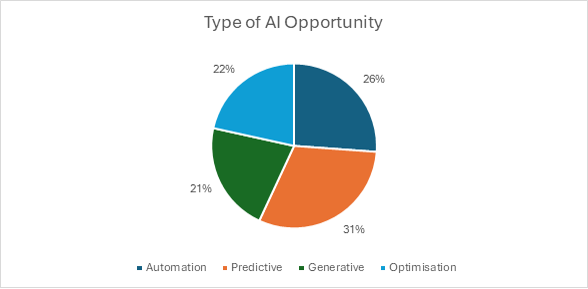
Predictive applications of AI were the most frequently identified opportunity, ahead of automation, generative, and optimisation. Forecasting and predictive modelling are therefore emerging as particularly relevant for risk identification and mitigation.
From Readiness to Responsible Adoption
Taken together, the action plans show that businesses primarily view AI as an enabler of better sustainability data, lower environmental impact and as a means of assisting staff in making more informed decisions. A focus on waste and circularity also featured strongly, appearing in half of the ambition plans. Overall, participants see AI as an opportunity worth pursuing, provided adoption is supported by the right organisational foundations.
However, before using AI to advance sustainability goals, businesses need an achievable pathway between their current capability and their overall ambition. Evidence from the programme indicates several areas that participants want to clarify or strengthen before adoption, particularly policy, governance, ownership, validation, data quality and systems integration. A phased approach can help organisations begin with appropriate use cases, learn from basic implementation and build readiness over time.
This was the second article in the series, the next article will examine one of the most important of these foundations: the human role in sustainable AI adoption.